The complete guide to learning tarot
Everything you need to start reading — and to go deeper.
01
What tarot is
Tarot is a deck of 78 illustrated cards that appeared in 15th-century Italy as a card game — the tarocchi. The hand-painted decks made for the Visconti-Sforza family in Milan are among the oldest that survive today.
Only in 18th-century France did tarot begin to be used as a symbolic and divinatory tool. The Tarot de Marseille established the classic iconography, and in 1909 the Rider-Waite-Smith deck — conceived by Arthur Edward Waite and illustrated by the artist Pamela Colman Smith — gave full scenes to the Minor Arcana too, becoming the basis of most modern decks, including this one.
Today tarot is used mainly as a language of self-knowledge: the cards are archetypes, universal images that help you see a situation from another angle, sort out feelings and make more conscious decisions.
02
The structure of the deck
The deck has two parts. The 22 Major Arcana (numbered 0 to XXI) represent life's great lessons and forces — love, power, death and rebirth, faith, destiny. When they appear in a reading, the matter carries weight and deep meaning.
The 56 Minor Arcana speak of everyday life: situations, emotions, thoughts and actions. They are divided into four suits of 14 cards: ten numbered cards (Ace to Ten) and four court cards (Page, Knight, Queen and King).
03
The Fool's Journey
One of the most beautiful ways to understand the Major Arcana is as a story: the Fool's Journey. The Fool (0) is the soul at the beginning of everything, free and innocent, setting out on a journey and meeting, card after card, life's teachers and trials.
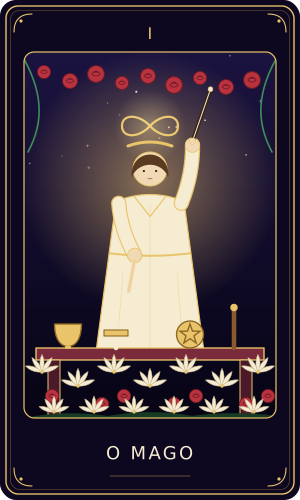
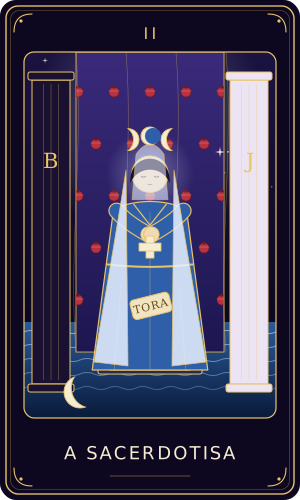
In the first stage (I to VII) the Fool learns about the outer world: will (The Magician), intuition (The High Priestess), abundance (The Empress), order (The Emperor), tradition (The Hierophant), the choice of love (The Lovers) and conquest (The Chariot).
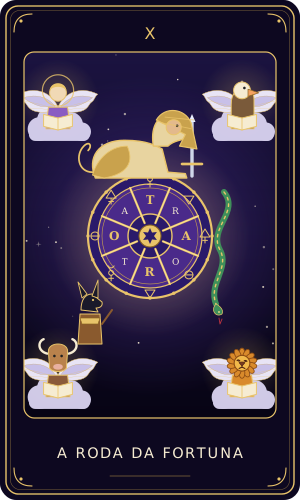
In the second stage (VIII to XIV) the Fool turns inward: inner strength, the Hermit's solitude, the cycles of the Wheel, Justice, the surrender of the Hanged Man, the transformation of Death and the balance of Temperance.
In the third stage (XV to XXI) the Fool faces the shadows (The Devil), watches old structures fall (The Tower) and is reborn in hope (The Star), crosses illusions (The Moon), blossoms in joy (The Sun), hears the call to awaken (Judgement) and finally becomes whole in The World — ready to begin again as a new Fool.
04
The suits and the four elements
Each suit is linked to a natural element and an area of life. Noticing which suit dominates a reading already tells you a lot about where the question lives.
| Suit | Element | Themes |
|---|---|---|
| Wands | Fire 🜂 | Action, creativity, passion, projects, life force |
| Cups | Water 🜄 | Emotions, love, intuition, relationships, dreams |
| Swords | Air 🜁 | Mind, communication, decisions, conflict, truth |
| Pentacles | Earth 🜃 | Work, money, body, health, tangible things |
05
Numerology of the Minor Arcana
Numbers tell a story of development that repeats in every suit. Combine the number's meaning with the suit's theme and you have the essence of any card — for example, the Five (conflict) of Cups (emotions) speaks of loss and emotional disappointment.
| Number | Meaning |
|---|---|
| Ace | Seed, pure potential, a new beginning |
| Two | Duality, choice, partnership, balance |
| Three | Growth, creation, expansion, collaboration |
| Four | Structure, stability, rest — or stagnation |
| Five | Conflict, crisis, loss, instability that moves things |
| Six | Harmony, generosity, healing, reciprocity |
| Seven | Reflection, assessment, strategy, tests |
| Eight | Movement, power, mastery, change |
| Nine | Almost there: culmination, intensity, solitude |
| Ten | End of a cycle, fullness or excess, legacy |
06
The court cards
Court cards can represent people in your life, parts of your personality or the way an energy shows up. Think of them as stages of maturity.
The Page is the student and messenger: curiosity, news, beginnings. The Knight is the young one on a mission: movement, drive, sometimes excess. The Queen masters the suit's energy from within: nurturing, emotional maturity, intuitive wisdom. The King masters it outwardly: leadership, responsibility, authority.
07
Reversed cards
When a card appears upside down, it is reversed. That doesn't automatically mean something bad. Generally, a reversal shows that the card's energy is blocked, delayed, turned inward, in excess or in the process of being released.
A difficult card reversed can even be a relief — the Ten of Swords reversed, for instance, speaks of recovery after hitting rock bottom. If you prefer, you can read without reversals: just untick the option before shuffling.
08
How to ask good questions
The quality of the answer depends on the quality of the question. Prefer open questions centered on you and on what is within your reach: instead of “Will they come back?”, ask “What do I need to understand about this relationship?”. Instead of “Will I be fired?”, ask “How can I strengthen my position at work?”.
For yes or no tarot, be objective and ask about a single thing. And avoid repeating the same question over and over: write the answer in your journal and watch how it unfolds.
09
How to read a spread — advanced techniques
1. Look at the whole before the details: are there many Major Arcana? Does one suit dominate? Many reversals? Many court cards? These first impressions set the tone of the reading.
2. Read each card in its position: the same Three of Swords means different things in “past” and in “advice”. The position is the question; the card is the answer.
3. Use elemental dignities: neighbouring cards of the same element strengthen each other; Fire and Air, and Water and Earth, are allies; Fire and Water, and Air and Earth, weaken each other. This shows which messages carry the most force.
4. Calculate the quintessence: add up the card numbers (Major Arcana by their number, numbered cards by their value, court cards don't count) and reduce the sum until it falls between 0 and 22. The corresponding Major Arcanum is the synthesis card, the underlying theme of the reading.
5. Tell a story: link the cards like chapters, from past to outcome. And always finish with a concrete action — tarot is most powerful when it becomes a choice.
10
Ethics and care
Tarot does not replace doctors, psychologists, lawyers or financial advisors. Use the cards to reflect, not to make irreversible decisions alone. Respect free will — yours and others' — and avoid reading about other people's lives without their consent.
If you are going through a time of intense distress, please reach out for help. In Brazil, CVV answers free of charge at 188, 24 hours a day; elsewhere, contact your local crisis line.
Recommendations for your practice
Items we use and recommend. Some are affiliate links: you pay nothing extra and you support the project.
- Rider-Waite-Smith TarotThe classic deck that inspires Arcano Celeste — perfect to begin.View in store
- Tarot de MarseilleThe French tradition, with pip-style Minor Arcana.View in store
- Tarot books for beginnersGuides to deepen meanings and reading techniques.View in store
- Tarot cloth & pouchTo protect your cards and create your reading space.View in store